Candlestick Chart Patterns: The Essential Guide for Stock Traders
Published on 8 min read
Master the most important candlestick patterns — from hammers and engulfing candles to doji and morning stars — and learn how to use them in your trading.
What Are Candlestick Charts?
Candlestick charts originated in 18th-century Japan, where rice traders developed them to track price movements in commodity markets. Today, they are the most widely used chart type among stock, forex, and crypto traders worldwide.
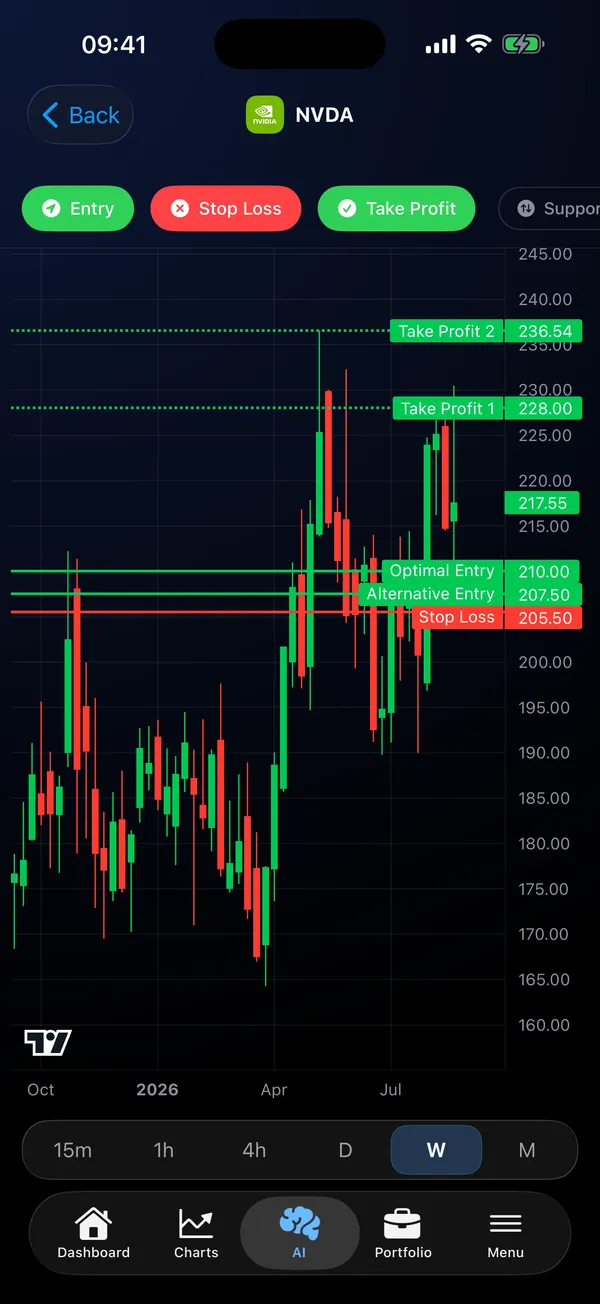
Each candlestick represents price action over a specific time period — whether a minute, an hour, a day, or a week. It displays four key data points: the open, close, high, and low prices. The rectangular body shows the range between open and close, while the thin lines extending above and below — called wicks or shadows — represent the high and low extremes.
A green (or white) candle means the close was higher than the open, signalling a bullish (upward) move. A red (or black) candle means the close was lower than the open, signalling a bearish (downward) move.
Compared to simple line charts or bar charts, candlesticks convey far more information at a glance: market sentiment, momentum shifts, and potential reversals — all in a single bar.
Essential Bullish Patterns
Hammer
The hammer appears after a downtrend and signals a potential reversal to the upside. It has a small body near the top of the candle and a long lower wick — at least twice the length of the body. The long lower wick shows that sellers pushed the price down significantly during the session, but buyers stepped in and drove it back up. The hammer tells you that selling pressure is weakening.
Bullish Engulfing
This two-candle pattern forms when a large green candle completely engulfs the body of the preceding red candle. It signals strong buying momentum overwhelming the prior selling pressure. The bigger the green candle relative to the red one, the more powerful the signal. Look for this pattern at the bottom of a downtrend for the strongest reversal signals.
Morning Star
The morning star is a three-candle reversal pattern. It begins with a large red candle (continued downtrend), followed by a small-bodied candle — which can be green or red — that gaps down (indecision), and concludes with a large green candle that closes well into the body of the first candle. This sequence marks a clear shift from bearish to bullish sentiment.
Essential Bearish Patterns
Shooting Star
The shooting star is the bearish mirror image of the hammer. It appears after an uptrend and has a small body near the bottom of the candle with a long upper wick. Buyers pushed prices higher during the session, but sellers took control and drove the price back down by the close. This suggests that buying momentum is fading.
Bearish Engulfing
The opposite of the bullish engulfing pattern: a large red candle completely engulfs the prior green candle. It signals that sellers have overwhelmed buyers and a reversal to the downside may follow. This pattern is most reliable when it appears at the top of an uptrend.
Evening Star
The evening star is the bearish counterpart to the morning star. It starts with a large green candle, followed by a small-bodied candle that gaps up (uncertainty at the highs), and ends with a large red candle that pushes deep into the body of the first candle. It signals a transition from bullish to bearish control.
Continuation Patterns
Doji
A doji forms when the open and close prices are nearly identical, resulting in a very thin or non-existent body. It represents indecision in the market — neither buyers nor sellers have clear control. A doji after a strong trend can signal that the trend is losing steam, but it requires confirmation from the following candle before acting on it.
Spinning Top
Like the doji, the spinning top has a small body but with noticeable upper and lower wicks of roughly equal length. It also signals indecision and a potential pause in the current trend. When found in clusters, spinning tops can indicate a period of consolidation before the next directional move.
How to Use Candlestick Patterns in Trading
Candlestick patterns are powerful, but they work best when used in combination with other tools and context:
Volume confirmation: A reversal pattern accompanied by high volume is far more reliable than one with low volume. Volume shows conviction behind the move.
Support and resistance: Patterns that form at key support or resistance levels carry more weight. A hammer at a major support level is a much stronger signal than a hammer in the middle of nowhere.
Technical indicators: Combining candlestick patterns with indicators like the RSI (Relative Strength Index) or MACD can improve accuracy. For example, a bullish engulfing pattern with an oversold RSI reading is a compelling setup.
Timeframe awareness: A pattern on a daily chart is generally more significant than the same pattern on a 5-minute chart. Higher timeframes filter out noise and produce more reliable signals.
Common Mistakes to Avoid
Trading patterns in isolation: No single candlestick pattern guarantees a reversal. Always look at the broader market context.
Ignoring the overall trend: A hammer in the middle of a strong downtrend is far less reliable than a hammer at a significant support level after a prolonged decline. Always trade with the trend, not against it, unless there is strong confluence.
Over-relying on single-candle patterns: Single-candle patterns like the hammer or shooting star are weaker than multi-candle patterns like the morning star or engulfing patterns. Require more confirmation for single-candle setups.
Not waiting for confirmation: Patience is key. Wait for the next candle to confirm the pattern before entering a trade. Acting too early often results in false signals.
Conclusion
Candlestick patterns are a foundational skill for any serious trader. They help you read market sentiment, spot potential turning points, and time your entries and exits more effectively. The key is to use them as part of a broader trading strategy — not as standalone signals.
If you want to take your technical analysis further, Stocks Analysis AI gives you access to 100+ technical indicators across 90+ global exchanges, letting you combine candlestick pattern recognition with the full depth of modern market analysis — all in one intuitive app.