7 Golden Rules of Stock Trading for Beginners
Published on 6 min read
New to stock trading? Follow these 7 essential rules to protect your capital, avoid common mistakes, and build a solid foundation for long-term success.
Why Rules Matter in Stock Trading
Starting your journey in the stock market is exciting — but it can also be overwhelming. Prices move fast, opinions are everywhere, and it's tempting to make decisions based on emotion rather than logic. This is exactly where most beginners go wrong.
Emotional decisions are the single biggest threat to new traders. When a stock drops, panic sets in and you sell at the worst moment. When a stock surges, greed takes over and you buy at the peak. Rules exist to protect you from yourself.
Successful traders don't rely on gut feelings. They follow systems, frameworks, and pre-defined rules that remove emotion from the equation. The market rewards discipline and punishes impulsiveness. If you want to build lasting wealth through trading, you need a set of rules you commit to — and stick with — regardless of what the market is doing.
Here are 7 golden rules every beginner should follow.
Rule 1: Never Risk More Than You Can Afford to Lose
This sounds obvious, but countless beginners ignore it. Before you invest a single dollar, ask yourself: "If I lost all of this, would it affect my life?" If the answer is yes, you're risking too much.
Only use money that is completely separate from your emergency fund, bills, rent, and daily expenses. Trading capital should be money you can genuinely afford to lose without impacting your quality of life.
Start small. There's no shame in beginning with a modest amount. You can always add more as you gain experience and confidence. Many successful traders started with just a few hundred dollars.
Better yet, use paper trading first. Most brokerages and trading apps offer paper trading — a simulated environment where you trade with fake money but real market data. This lets you practice strategies, learn the platform, and build confidence before putting real capital at risk.
Rule 2: Always Use a Stop-Loss
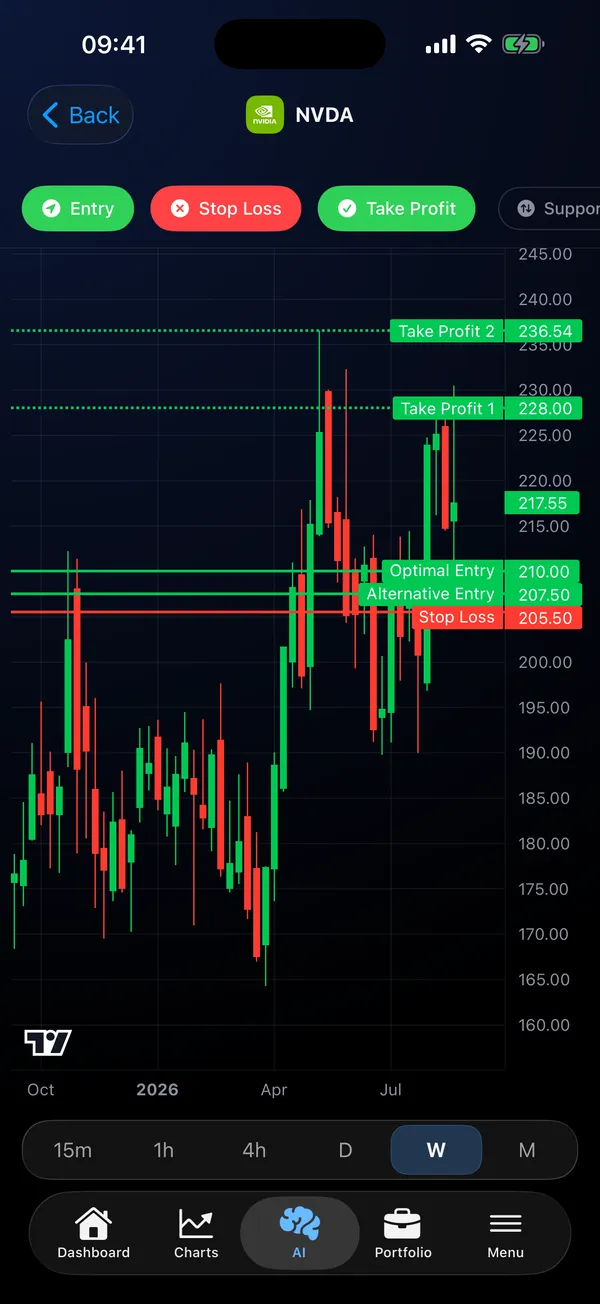
A stop-loss is your safety net. It's a pre-set price at which your position automatically closes, capping your loss at an amount you've already decided you can accept.
Define your maximum loss before you enter any trade. For example, if you buy a stock at $50, decide in advance that you're willing to lose no more than 10% — meaning you'd set your stop-loss at $45. If the stock drops to $45, you exit automatically. You don't hesitate, you don't hope it recovers — you exit.
Set your stop-loss as soon as you open a position. Waiting until a stock starts falling to decide where your stop is is a recipe for disaster. By then, emotion is already influencing your thinking.
The most important rule within this rule: never move your stop-loss further away from your entry. This is a common beginner mistake. When a stock approaches your stop and you think "maybe I'll give it a little more room," you're letting hope override your plan. That extra room often turns a small, manageable loss into a devastating one.
Rule 3: Do Your Research Before Buying
Never buy a stock just because someone mentioned it, or because it appeared on a trending list. Do your own research first.
Start with the basics: understand what the company actually does. What product or service do they sell? Who are their customers? What industry are they in? If you can't explain the business in two sentences, keep researching.
Next, check the fundamentals. Look at revenue growth, earnings per share, profit margins, and debt levels. You don't need to be an accountant, but understanding whether a company is profitable and growing is essential.
Then look at the chart. Technical analysis helps you identify the right time to enter a trade. Don't buy a stock that is in a clear downtrend — you're trying to catch a falling knife. Look for stocks that are consolidating or beginning an uptrend. Use technical indicators like moving averages, RSI, and volume to time your entry more precisely.
Rule 4: Don't Chase Hot Tips or Hype
Social media, online forums, and financial news can be useful — but they can also be extremely dangerous for beginners. When a stock is all over Reddit, Twitter, or CNBC, it almost always means the easy money has already been made.
If everyone is talking about a stock, you are probably late. The people who profit from hype are those who got in early, long before the news broke. By the time retail investors pile in, the smart money is often already exiting.
FOMO — fear of missing out — is one of the most destructive forces in trading. It causes you to buy at the top, hold through the crash, and sell at the bottom. Every time you feel an urgent need to buy something because "it's going to keep going up," take a breath and revisit your research process.
There's always another opportunity. Missing one trade is far better than losing your capital chasing hype.
Rule 5: Diversify Your Portfolio
Putting all your money into a single stock or sector is one of the most dangerous things a beginner can do. No matter how convinced you are that a particular stock will rise, the market can always surprise you.
Spread your investments across different companies, different industries, and different market capitalizations (large-cap, mid-cap, small-cap). If one sector takes a hit — say, technology stocks fall during a rate hike cycle — your other holdings in healthcare, energy, or consumer staples can cushion the blow.
Consider geographic diversification as well. Investing only in domestic stocks exposes you to country-specific risks like political instability, regulatory changes, or economic downturns. Global diversification provides a broader safety net.
A simple rule of thumb: no single stock should represent more than 10–15% of your total portfolio. This way, even if one position goes to zero, your overall portfolio survives.
Rule 6: Keep a Trading Journal
A trading journal is one of the most underused tools in a beginner's arsenal. Every time you make a trade, write down the details: the ticker, entry price, exit price, position size, your reasoning for entering, and the outcome.
More importantly, review your journal regularly — at least once a week. Look for patterns. Are you consistently losing on certain types of trades? Are you exiting profitable trades too early? Are your losses usually caused by breaking your own rules?
A journal turns every loss into a lesson. Without it, you're likely to repeat the same mistakes over and over without realizing it. The traders who improve fastest are those who treat every trade — win or lose — as data to learn from.
Rule 7: Be Patient and Think Long-Term
Not every day requires a trade. In fact, some of the best traders make only a handful of trades per month. Overtrading is a common beginner mistake — it generates transaction costs, increases your exposure to bad trades, and wears down your discipline.
Wait for high-quality setups that match your strategy. The best opportunities come to those who are patient enough to wait for them. If the market doesn't present a clear opportunity on a given day, the right move is to do nothing.
Think long-term. The most powerful force in investing is compounding — the ability of gains to generate further gains over time. Even modest annual returns, compounded over many years, produce remarkable results. The traders who win in the long run are those who protect their capital, stay consistent, and let time work in their favor.
Building Your Foundation
Trading is a skill, and like any skill, it takes time, practice, and ongoing learning to develop. These 7 rules won't guarantee profits, but they will protect you from the most common and costly beginner mistakes.
As you develop your trading strategy, having the right tools makes a significant difference. Stocks Analysis AI gives you access to 100+ technical indicators across 90+ global exchanges, helping you research stocks, time your entries, and make more informed decisions — all in one place. The more informed your decisions, the better your results over time.