Risk/Reward Ratio: What It Is and How to Calculate It
Published on 6 min read
Master the risk/reward ratio — learn how to calculate it, why it matters more than win rate, and how to apply it to every trade you make.
What Is the Risk/Reward Ratio?
The risk/reward ratio is one of the most fundamental concepts in trading. It compares the amount of money you stand to lose on a trade against the amount you stand to gain. Expressed as a simple ratio — 1:2, 1:3, 1:4 — it gives you an immediate snapshot of whether a trade is worth taking.
A ratio of 1:2 means you are risking $1 to potentially make $2. A 1:3 ratio means risking $1 for a potential $3 gain. The higher the reward side of the equation, the more attractive the trade becomes — assuming the target is realistic.
This single metric sits at the foundation of profitable, sustainable trading. Without it, you are essentially guessing.
Why Risk/Reward Matters
Here is a truth that surprises many new traders: you do not need to win the majority of your trades to be consistently profitable. What matters far more is the ratio between your winners and your losers.
Consider a trader using a 1:3 risk/reward ratio. Even if they are wrong 60% of the time, the 40% of winning trades can more than offset the losses. The math works in their favour because each win pays out three times more than each loss costs.
The table below shows the minimum win rate required just to break even at different ratios:
| R/R Ratio | Min Win Rate to Break Even |
|---|---|
| 1:1 | 50% |
| 1:2 | 33% |
| 1:3 | 25% |
| 1:4 | 20% |
This is why professional traders focus relentlessly on finding high-quality setups with favourable ratios, rather than chasing a high win percentage. A 40% win rate with a 1:3 ratio is far more valuable than a 70% win rate with a 1:1 ratio.
How to Calculate Risk/Reward
Calculating the ratio is straightforward once you have three price levels defined:
- Risk = Entry Price − Stop-Loss Price
- Reward = Target Price − Entry Price
- Ratio = Risk ÷ Reward (expressed as 1:X)
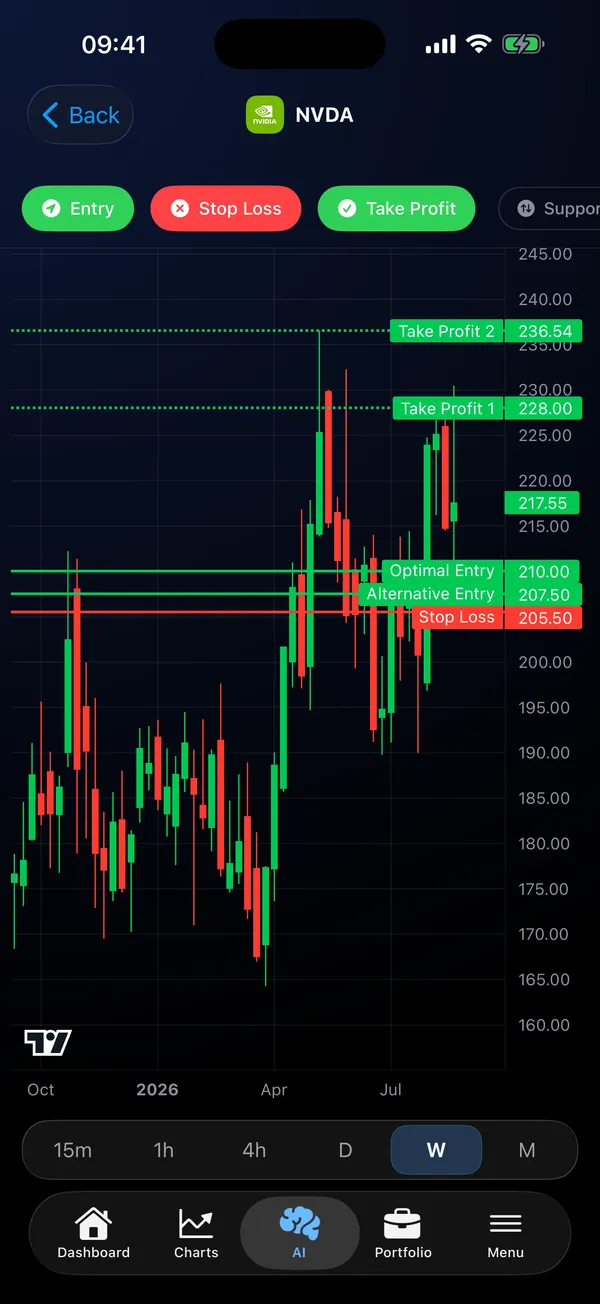
Let's walk through a concrete example. Suppose you decide to buy a stock at $50. You place your stop-loss at $48, protecting you from a larger loss if the trade moves against you. Your analysis suggests a target price of $56 based on a key resistance level.
- Risk = $50 − $48 = $2 per share
- Reward = $56 − $50 = $6 per share
- Ratio = $2 / $6 = 1:3
This is a trade worth considering. You risk $2 to potentially make $6. Even if you only win one third of such trades, you will break even — and anything above that is profit.
Setting Realistic Targets
One of the most common mistakes traders make is setting arbitrary profit targets that have no relationship to what the chart is actually showing. A realistic target is not simply "twice my stop-loss distance" placed at random — it needs to be anchored to meaningful price levels.
Here are the most reliable methods for identifying profit targets:
Support and resistance levels are your primary guide. Previous areas where price has reversed or stalled represent natural zones where selling pressure tends to emerge on the way up.
Fibonacci extensions are widely used for projecting how far a move might travel beyond a prior swing high. The 1.618 and 2.618 extension levels are particularly common targets among technical traders.
Previous swing highs and lows mark the price levels where the market has already made decisions. A stock that broke out above a prior high will often use that level as a target on the next advance.
The key principle: let the chart tell you where the target should be. Do not force a 1:3 ratio onto a trade where the chart only supports 1:1.5. If the ratio is not there, the trade is not there.
Applying Risk/Reward to Your Trading Plan
Pre-Trade Checklist
Before entering any position, work through this checklist:
- Identify your entry point based on your setup
- Set your stop-loss at a technically meaningful level (below support, above resistance)
- Calculate your risk per share (entry minus stop)
- Identify your target level using chart structure
- Calculate your reward per share (target minus entry)
- Only take the trade if the ratio is at least 1:2
If you cannot complete all six steps with confidence, the trade is not ready.
Position Sizing Integration
The risk/reward ratio becomes even more powerful when combined with disciplined position sizing. A common approach is the 1% rule: never risk more than 1% of your account on a single trade.
Here is how it works in practice. Say you have a $10,000 trading account. Your maximum risk per trade is $100 (1% of $10,000). If your analysis shows a risk of $2 per share, you divide $100 by $2 to arrive at a position size of 50 shares.
This approach keeps individual losses manageable regardless of how many consecutive losing trades occur. Combined with a strong risk/reward ratio, it gives you the statistical edge to survive drawdowns and remain in the game long enough for your edge to play out.
Common Mistakes
Even traders who understand the concept intellectually often fall into these traps:
Setting unrealistic reward targets. Projecting a 1:5 ratio on a trade when the nearest resistance level only supports 1:1.5 is wishful thinking, not analysis.
Ignoring the ratio and trading on impulse. Excitement about a setup often causes traders to skip the math entirely. Always calculate before you click.
Moving targets closer when price stalls. If price hesitates before reaching your target, the temptation is to lock in a smaller profit. This collapses your ratio and destroys the statistical edge you started with.
Not accounting for commissions and fees. On smaller accounts, transaction costs can meaningfully erode a 1:2 ratio. Always calculate your net risk and net reward after fees.
Using fixed ratios without considering market conditions. A 1:3 ratio that works well in trending markets may be unrealistic in choppy, range-bound conditions. Adapt your targets to the current environment.
Conclusion
The risk/reward ratio is not just a formula — it is a mindset shift. Once you internalize it, you stop asking "will this trade win?" and start asking "is this trade worth the risk?" That single change in thinking separates consistent traders from gamblers.
Calculate every trade before you enter. Respect the ratio. Let the chart set your targets. If the numbers do not support the trade, walk away and find a better setup.
For traders who want a structured way to apply these principles, Stocks Analysis AI provides access to 100+ technical indicators across 90+ global exchanges, making it easier to identify high-quality setups with clearly defined entry points, stop levels, and profit targets — all in one place.