Stop-Loss Strategies: How to Protect Your Trading Capital
Published on 7 min read
Discover the most effective stop-loss strategies — from fixed percentage to ATR-based stops — and learn how to size your positions to manage risk like a pro.
Why Stop-Loss Orders Matter
Every successful trader shares one fundamental priority: protecting capital. Before thinking about profits, you must ensure that a single bad trade cannot devastate your account. Stop-loss orders are the primary tool for achieving this.
A stop-loss is an order placed with your broker to sell a position automatically if it falls to a specified price. When a trade moves against you, the stop-loss exits the position before losses spiral out of control. Small losses are part of trading — they are manageable, recoverable, and expected. Large, uncontrolled losses, however, can permanently damage your account and your trading career.
Beyond the financial protection, stop-losses serve a critical psychological function. Trading without them forces you to make emotional decisions in real time: "Should I hold a little longer? Maybe it will bounce back." This hope-driven thinking is one of the most dangerous patterns in trading. A pre-set stop-loss removes emotion from the equation entirely. You define your maximum acceptable loss before the trade begins, and you let the rules handle the exit.
The classic principle — "cut your losses short, let your winners run" — is not just a catchy phrase. It is a mathematically sound strategy. A trader who consistently limits losses to 5–8% while letting winners reach 15–20% will be profitable even with a win rate below 50%.
Types of Stop-Loss Orders
Fixed Percentage Stop
The simplest approach is to set a stop-loss at a fixed percentage below your entry price — commonly 5%, 8%, or 10%. If you buy a stock at $100 and use an 8% stop, your exit triggers at $92.
This method is straightforward and easy to implement, making it ideal for beginners. Its limitation is that it ignores the stock's natural behavior — a highly volatile stock may swing 8% in a single session without any meaningful change in trend.
Technical Stop-Loss
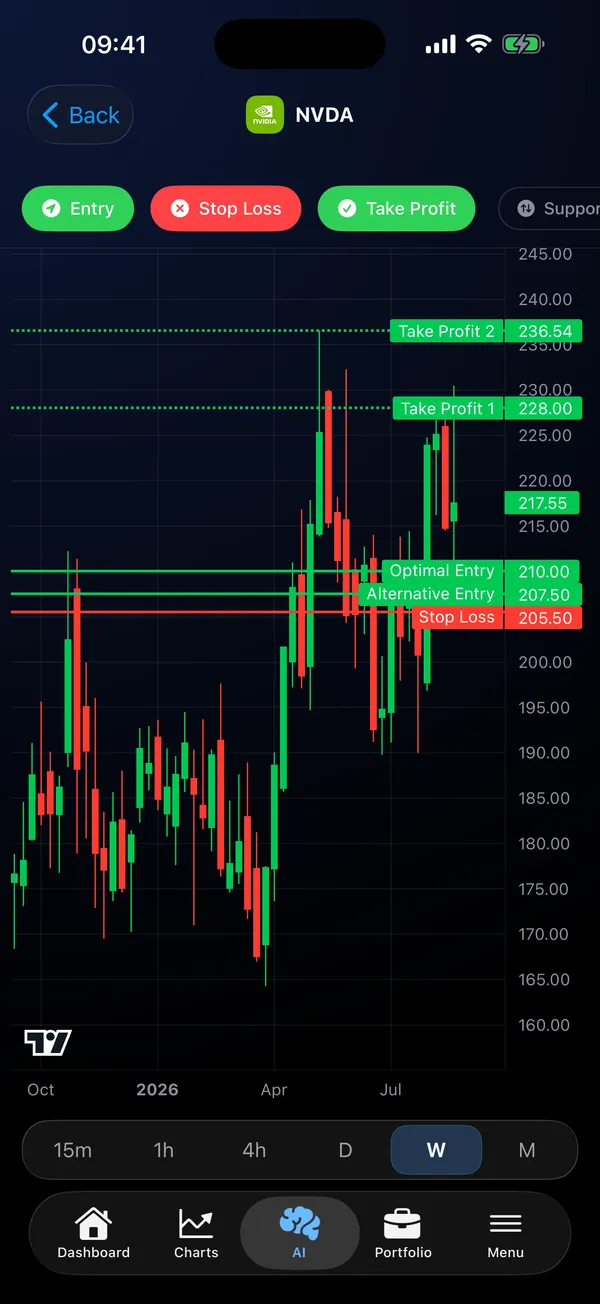
A more sophisticated approach places the stop-loss below a key technical level: a support zone, a moving average (such as the 50-day or 200-day MA), or a recent swing low. The logic is that if the price breaks below a significant support level, the original thesis for the trade is invalidated.
Technical stops are based on chart structure rather than arbitrary percentages. They adapt to each stock's unique behavior and tend to be more meaningful. The trade-off is that they require chart-reading skills and more analysis.
Trailing Stop-Loss
A trailing stop moves upward as the stock price rises, locking in profits while still protecting against a reversal. If you set a 10% trailing stop and the stock climbs from $100 to $130, your stop moves from $90 to $117. A subsequent decline to $117 triggers the exit, securing a 17% gain.
Trailing stops are powerful for trend-following strategies. They allow you to stay in a strong move without pre-defining an exact exit target, while automatically protecting the gains you have accumulated.
Volatility-Based Stop (ATR Stop)
The Average True Range (ATR) measures how much a stock typically moves in a single day. An ATR-based stop places the exit at a multiple of the ATR below the entry — for example, 2× ATR. This means the stop is wider for volatile stocks and tighter for stable ones, making it proportionate to each stock's natural behavior.
ATR stops are considered one of the most adaptive and rational stop-loss methods available. They prevent being stopped out by normal daily fluctuations while still protecting against genuine trend reversals.
How to Set Effective Stop-Losses
Setting a good stop-loss requires more than picking a number. Consider the stock's average daily range — if it moves $3 per day on average, a $1 stop will be triggered constantly by noise. Give the trade enough room to breathe.
Avoid placing stops at obvious round numbers ($50.00, $100.00) or at the exact same price as widely-watched support levels. These are the prices where everyone else places their stops, and institutional traders know it. Place your stop slightly below the key level to avoid being swept out by a brief liquidity hunt.
Always factor in your risk/reward ratio before entering a trade. A standard minimum is 1:2 — meaning you risk $1 to potentially make $2. If your stop-loss gives you a poor risk/reward ratio, the trade may not be worth taking.
Position Sizing and Stop-Losses
Stop-losses and position sizing work together as a unified risk management system. Knowing where to exit is only half the equation — you also need to know how much to buy.
The 1% rule is a widely respected guideline: never risk more than 1% of your total account on a single trade. For a $10,000 account, the maximum risk per trade is $100.
The formula is straightforward:
Position Size = Risk Amount ÷ Stop Distance
For example: You have a $10,000 account and plan to risk 1% ($100). You buy a stock at $50 with a stop at $47 — a $3 stop distance. Position Size = $100 ÷ $3 = 33 shares. You buy 33 shares, knowing that if the stop triggers, you lose approximately $100.
This approach keeps losses small and consistent regardless of the stock's price or volatility.
Common Stop-Loss Mistakes
Setting stops too tight: A stop placed too close to the entry gets triggered by ordinary market noise, not by a genuine trend change. You exit prematurely and watch the stock continue in your intended direction.
Setting stops too wide: A stop that is too far away means accepting an unnecessarily large loss when it does trigger. This also forces you to reduce position size so drastically that even a winning trade barely moves the needle.
Moving stops away from entry: This is one of the most destructive habits in trading. When a stop is about to be hit, some traders move it further away hoping for a recovery. This converts a manageable loss into a potentially catastrophic one.
Not using stops at all: Trading without stop-losses is speculating without a safety net. All it takes is one unexpected event — an earnings miss, a regulatory announcement, a market crash — to cause devastating losses.
Placing stops at the exact crowd level: When everyone places stops at the same obvious price, market makers and algorithms can briefly push the price through that level, trigger the stops, then reverse. This is called a "stop hunt." Offset your stop by a few cents or a small buffer to avoid it.
Conclusion
Stop-loss strategies are not optional for serious traders — they are the foundation of long-term survival in the markets. By understanding the different types of stops, sizing your positions correctly, and avoiding the common mistakes, you give yourself a systematic edge over emotional, undisciplined trading.
Tools like Stocks Analysis AI can help you make smarter stop-loss decisions by providing access to 100+ technical indicators across 90+ global exchanges. From ATR calculations to moving average overlays and support/resistance detection, having the right data at your fingertips makes it far easier to place stops where they actually make sense — not just where they feel comfortable.