Top 5 Stock Trading Mistakes (And How to Avoid Them)
Published on 7 min read
Even experienced traders fall into common traps. Discover the 5 most costly stock trading mistakes and learn practical strategies to protect your portfolio.
Introduction
Stock trading is one of the most exciting ways to grow your wealth — but it's also one of the easiest ways to lose it. Whether you're just getting started or you've been trading for a few years, certain mistakes show up again and again across all experience levels. The good news? They're entirely avoidable once you know what to look for.
In this article, we'll walk through the five most common stock trading mistakes, why they happen, and — most importantly — how to stop them from derailing your portfolio.
Mistake 1: Trading Without a Plan
Imagine getting into your car and driving with no destination in mind. You might end up somewhere interesting, but you're just as likely to get lost or run out of gas. Trading without a plan works exactly the same way.
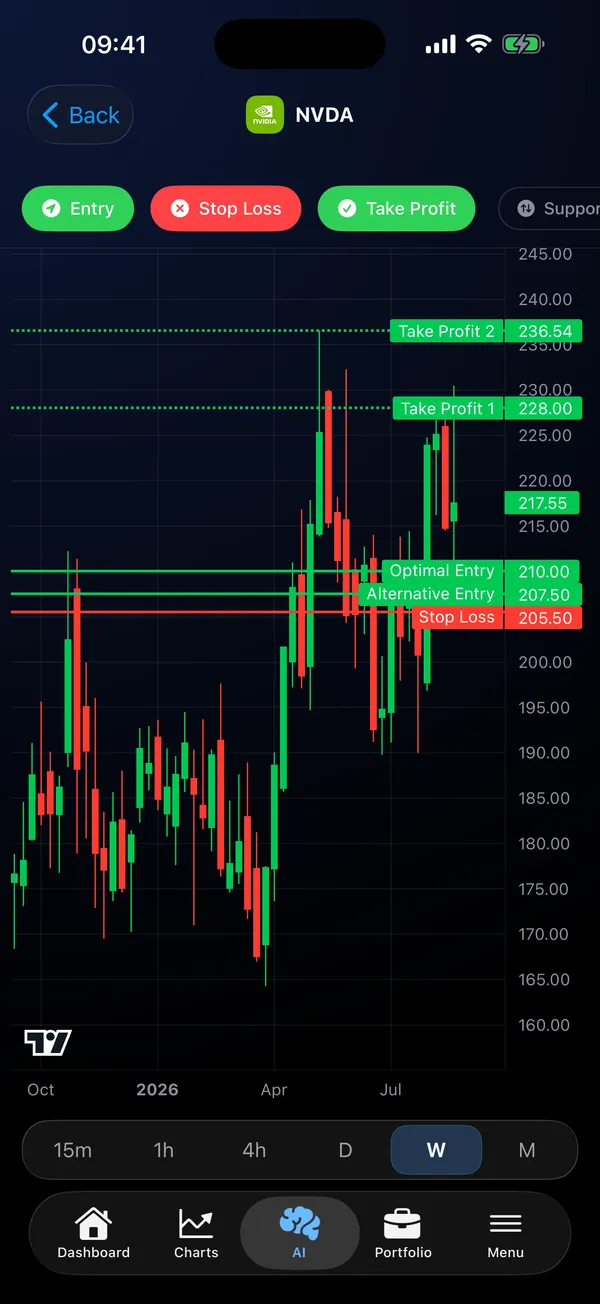
A solid trading plan answers three fundamental questions: When will I enter a trade? When will I exit — both at a profit and at a loss? And how much of my capital am I willing to risk on this trade?
Without clear answers to these questions, decisions become reactive rather than strategic. You end up holding losing positions too long hoping they'll recover, or selling winners too early out of nerves. Successful traders treat every trade like a business decision, with predefined rules that remove emotion from the equation.
What to do instead: Before entering any trade, write down your entry criteria, your profit target, and your stop-loss level. Stick to it.
Mistake 2: Ignoring Technical Indicators
Many beginner traders rely heavily on "gut feeling" or tips from social media. While intuition can occasionally be right, consistently profitable trading requires data-driven decisions.
Technical indicators are tools that analyze price and volume data to help you understand market momentum, trend direction, and potential reversal points. Three of the most widely used are:
- RSI (Relative Strength Index): Measures whether a stock is overbought or oversold on a scale of 0–100. A reading above 70 often signals a stock may be due for a pullback; below 30 can indicate oversold conditions.
- MACD (Moving Average Convergence Divergence): Helps identify trend changes and momentum shifts by comparing two moving averages. A MACD crossover is often used as a buy or sell signal.
- Bollinger Bands: Plot bands around price movement based on standard deviation. When price touches the upper band, it may be overbought; the lower band may indicate oversold conditions.
None of these indicators are perfect in isolation, but used together they paint a much clearer picture of what a stock might do next.
What to do instead: Learn the basics of two or three key indicators and apply them consistently before making trade decisions.
Mistake 3: Overleveraging and Poor Risk Management
Leverage can amplify your gains — but it amplifies your losses just as fast. One of the most common ways traders blow up their accounts is by risking too much on a single trade or using margin without a full understanding of the downside.
Professional traders typically risk no more than 1–2% of their total capital on any single trade. If you have a $10,000 portfolio, that means never risking more than $100–$200 on one position. This may sound overly conservative, but it means you can absorb a long string of losing trades without wiping out your account.
Stop-loss orders are your safety net. A stop-loss automatically exits your position if the price falls to a level you've predetermined, preventing a bad trade from becoming a catastrophic one.
What to do instead: Define your risk per trade before entering. Always use stop-loss orders. Never risk money you can't afford to lose.
Mistake 4: Emotional Trading — FOMO and Panic Selling
Two emotions dominate bad trading decisions: fear and greed. They show up as FOMO (Fear Of Missing Out) and panic selling, and they're responsible for an enormous amount of portfolio damage.
FOMO happens when a stock has already surged and you jump in late because you don't want to miss the move. You buy at the top, the momentum reverses, and you're left holding a loss. Panic selling is the opposite — when a stock drops, fear takes over and you sell at the bottom, locking in losses right before a recovery.
The antidote to emotional trading is a combination of a solid plan (see Mistake 1) and genuine trust in your analysis. When you've done your research and defined your rules in advance, you don't need to make decisions in the heat of the moment.
What to do instead: Keep a trading journal. Write down why you entered each trade and review it regularly. Pattern recognition in your own behavior is the most powerful tool you have.
Mistake 5: Not Diversifying Your Portfolio
"Don't put all your eggs in one basket" is a cliché for a reason. Concentration risk — having too much of your portfolio in a single stock or sector — can be devastating when things go wrong.
Consider what happened to investors who were heavily concentrated in tech stocks during the 2022 correction, or in energy stocks during the 2020 oil price crash. Even great companies go through rough patches, and sector-wide downturns can hit hard.
A well-diversified portfolio spreads risk across different sectors (technology, healthcare, financials, energy, consumer goods), different geographies, and different asset classes. You don't need to own hundreds of stocks — even 10–15 carefully chosen positions across different industries can dramatically reduce your exposure to any single event.
What to do instead: Review your portfolio allocation regularly. If any single stock represents more than 10–15% of your total portfolio, consider rebalancing.
How to Avoid These Mistakes
Avoiding these mistakes isn't about being smarter than the market — it's about building better habits and using the right tools. Here are five practical steps:
- Create and follow a written trading plan. No trade without predefined entry, exit, and risk rules.
- Learn to read technical indicators. RSI, MACD, and Bollinger Bands are good starting points.
- Manage your risk on every trade. Never risk more than 1–2% of capital on a single position.
- Trade with discipline, not emotion. A trading journal helps you catch emotional patterns before they cost you.
- Diversify intentionally. Spread your positions across sectors and review your allocation regularly.
Technology can also be a major ally here. Modern trading analysis tools give you access to real-time data, multiple technical indicators, and portfolio insights in one place — making it far easier to stick to your plan and make data-driven decisions.
Conclusion
Every trader makes mistakes — the goal is to make them less often and recover from them faster. By trading with a plan, respecting technical indicators, managing your risk, keeping emotions in check, and diversifying properly, you put yourself on the right side of the odds.
Stocks Analysis AI helps you avoid these mistakes by providing AI-powered analysis, real-time data from 90+ exchanges, and 100+ technical indicators. Let data guide your decisions — download the app today.